Tuesday, 3 July 2012

South Africa hopes carbon capture will make coal a clean energy source


JOHANNESBURG (miningweekly.com) – South Africa’s support for the outcomes of the United Nations Conference on Sustainable Development, held in Rio de Janeiro from June 20 to June 22, and known as Rio+20 for short, does not mean the country is going to turn its back on coal.
“As South Africa, we are not about to abandon our coal reserves,” assured Water Affairs and Environment Minister Edna Molewa in Pretoria on Monday. She was briefing the media on the outcomes of the conference.
“We are not going to throw our coal into the sea,” concurred Women, Children and People with Disabilities Minister Lulu Xingwana at the same briefing. “We are going to use clean technologies to improve our coal.” Read more here...

Monday, 25 June 2012

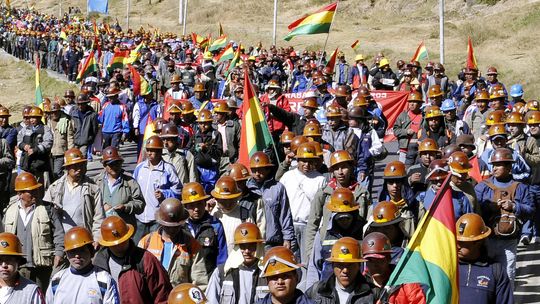
Glencore protests at Bolivia mine nationalisation


LONDON – Angered by the nationalisation of a tin and zinc mine in Bolivia, global commodities firm Glencore said on Friday it may seek compensation domestically or abroad.
Bolivia's leftist government, headed by Evo Morales, took over operations at the Colquiri mine on Wednesday after weeks of violent protests.
Morales, who has already nationalised the Andean country's natural gas and electricity industries, said the decree brought the local operating company Sinchi Wayra - which has been owned by Glencore since 2005 - back into state hands, resolving the dispute between employees and independent miners that has left 18 injured. Read more here...

To whose mining tune will next week’s ANC Policy Conference dance?


JOHANNESBURG (miningweekly.com) – The ultimate outcome of South African mining industry policy could be decided next week when the National Policy Conference of the ruling African National Congress (ANC) takes place from June 26 to 29.
On the eve of the conference, Mineral Resources Minister Susan Shabangu has expressed the hope that South Africa’s marathon debate on the nationalisation of its mining industry will be finally “laid to rest”.
Shabangu has herself expressed the strongest “not in my lifetime” views about mine nationalisation and President Jacob Zuma and leading members of his Cabinet have consistently reiterated that nationalisation is not government policy. Read more here...

AngloGold reports Moab Khotsong fatality


JOHANNESBURG (miningweekly.com) – South African miner AngloGold Ashanti on Friday reported a fatal accident at its Moab Khotsong mine, near Orkney.
The company stated that a driller was struck by a fall of ground, on Thursday.
It said in a statement that management suspended all drilling and blasting operations at the mine, though safety-related activities such as installing support continue.
Members of the Department of Mineral Resources inspectorate would be carrying out an inspection of the scene of the accident.
This is the fourth fatality at an AngloGold Ashanti mine this year. Last week, the company reported a mine death at its Great Noligwa operation, near Klerksdorp.

Local HSE culture benefits from global support


While health, safety and environ- ment (HSE) challenges in South Africa are similar to those in other parts of the world, Fluor South Africa is also tasked with managing diverse cultures and groups, often with different belief systems and languages, as one uniform team in complex work environments.
Fluor corporate HSE Africa director Shane van der Nest tells Mining Weekly that because each project site is unique, health and safety plans consistent with Fluor’s global practices are tailored to each and every site. Project site-specific plans are also tailored to adhere to local regulatory, contractual and client-specific requirements.
“In South Africa, we use a broad communication strategy that includes multiple languages and visual representations of safety practices to help unify and inform workers. Pictorial booklets are used to illustrate lessons learned, safe work practices and HSE tools,” says Van der Nest. Read more here...

Peru's Humala says water guaranteed near Newmont mine


Ollanta Humala 

LIMA - Peruvian president Ollanta Humala said on Saturday Newmont Mining would ensure ample water for towns near its proposed Conga gold mine, and that his government would not allow new mines to open if they hurt water supplies.
US-based Newmont on Friday accepted a stricter environmental mitigation plan for its mine, which will now require total investments of $5-billion, making it the most expensive mine in Peruvian history.
Newmont said that before the mine is built it will first build larger reservoirs that will guarantee year-round water supplies in towns currently suffering shortages. The bigger reservoirs are expected to add up to $200-million to the project's original $4.8-billion price tag and take up to two years to build. Read more here...

Newmont accepts stricter conditions for Peru mine


LIMA - Newmont Mining said on Friday it has accepted a stricter environmental mitigation plan for its $4.8-billion Conga gold mine and could resume work on the massive project.
Conga, the biggest mining project ever proposed in Peru, has been stalled since November because of ongoing protests by community groups who say it would hurt water supplies and cause pollution.
Newmont said that before the mine is built it will first build reservoirs that will guarantee year-round water supplies in towns that currently suffer shortages.
In an attempt to quell protests, the government had hired outside experts to recommend improvements to the company's own environmental impact plan. Read more here...

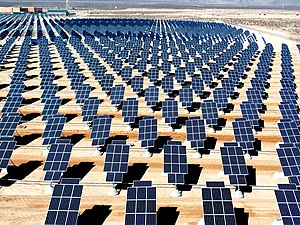
Company on the brink of proving solar energy benefits to industry


Energy and lifestyle solutions provider Optimum PM is on the brink of proving the viability of solar energy technology in the mining industry by running pilot programmes at mining operations across South Africa. This will silence the doubts regarding the use of this renewable technology in mining operations, states Optimum PM energy executive director and founder John Shiri.
The company states that it is in the process of negotiating with mining companies to install solar-based heating and cooling plants with heat pumps that use heat from the bedrock, to supplement power systems that reduce operational costs including maintenance costs of mines and processing plants. Read more here...

Fatalities, adverse ground conditions delay Ghaghoo production


JOHANNESBURG (miningweekly.com) – London-listed diamond producer Gem Diamonds on Monday said two contract workers died at its Ghaghoo underground mine project, in Botswana, when the ground collapsed at the face of the tunnel development.
The combination of the fatalities – the mine’s first in 2012 – and adverse ground conditions, was expected to delay the start of first diamond production until the first half of 2014.
Production at the Ghaghoo mine, which is located about 200 km north of Gaborone and falls within the Central Kalahari Game Reserve, was initially anticipated to start during the third quarter of 2013 at an initial rate of 100 000 ct/y, to be increased over time to a peak of 780 000 ct/y. Read more here...

Wednesday, 23 May 2012

Worker killed at Northam’s Zondereinde mine


JOHANNESBURG (miningweekly.com) – A worker has died at JSE-listed Northam Platinum’s Zondereinde mine, in Limpopo, following a fall-of-ground incident on Tuesday.
Work at the affected shaft was suspended following a Section 54 order by the Department of Mineral Resources.
The company said no other employees had sustained injuries.
Last year, three workers were killed at the mine.

Brazilian group targeting more African opportunities


Brazilian diversified mining major Vale has confirmed that its portfolio includes investments of $7.7-billion in projects in nine African countries. Speaking at a recent seminar on Africa hosted by Brazil’s National Economic and Social Development Bank (better known by its Portuguese initials, BNDES), Vale CEO Murilo Ferreira reaffirmed the importance of Africa in his company’s strategy.
He highlighted that Vale continued to be interested in the continent and specifically cited coal and copper as sectors in which Vale continued to make investments in Africa. These sectors have the potential to grow Vale’s African business, he pointed out. 
“For example, our investment in Mozambique is high –” said Ferreira, “equivalent to a third of the gross domestic product of that country.” Read more here...

De Beers mounts rescue bid for trapped illegal Namaqua diamond diggers


JOHANNESBURG (miningweekly.com) – Diamond miner De Beers has mounted a rescue bid for at least seven illegal diamond diggers who are trapped in illegally excavated tunnels at De Beers' Namaqua diamond mines in the Northern Cape.
De Beers and Namaqualand Mines said that the illegal diggers were working in the Bontekoe area on the northern boundary of Namaqualand Mines and State-owned land.
De Beers is in the process of transferring the operation to JSE-listed Trans Hex.
Mine management confirm that one person has been rescued and taken to hospital, and six or more people are being sought. Read more here...

Monday, 14 May 2012

Argonaut wants S Australia govt to focus on legislation change


PERTH (miningweekly.com) - ASX-listed Argonaut Resources on Friday welcomed the Australian High Court’s decision to reject an application by the South Australian government to appeal against a Supreme Court decision that overturned an approval by the Aboriginal Affairs Minister allowing for exploration at the Lake Torrens area.
Argonaut and its joint venture (JV) partner Straits Resources had sought rights to explore on a small area of Lake Torrens, and in addition to native title approvals, the JV had sought Aboriginal heritage authorisation from the Minister, which was subsequently granted.
However, the authorisation became the subject of a judicial review in 2011, and the Supreme Court found that the Minister for Aboriginal Heritage had failed to afford traditional owners procedural fairness in granting the authorisation. Read more here...

Draft regulations to improve dust management on mines


The introduction of dust control regulations, which are currently being drafted, could result in potential liabilities for opencast mines in South Africa and have a definite impact on the already extensively regulated mining industry, says business law firm Bell Dewar.
In May last year, the Department of Envi- ronmental Affairs released the draft National Dust Control Regulations, under Section 32 of the National Environmental Management: Air Quality Act of 2004, for public comment.
The regulations are aimed at prescribing general measures for the control of dust in all areas, including residential and light commer- cial areas.
The draft regulations propose the prohibition of dust pollution above specified levels and the establishment of criminal liability for noncompliance, as well as new tools for air quality offi- cers to better monitor dust emissions. Read more here...

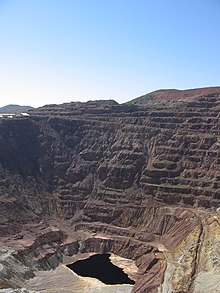
Environmental impact weighs heavy on opencast mining operations


Opencast mining has become increasingly unpopular with non-governmental organisations and government authorities owing to its high environmental footprint, but the method is still the most economical option for mining houses, says minerals industry consultant Venmyn director Neil McKenna.
“Compared with underground mining, the single biggest challenge faced by opencast mining is its environmental impact as a result of the large mining footprint associated with bulk commodity mining.”

For instance, the South Cotabato province of the Philippines banned opencast mining in 2010. The ban is hindering the progress of diversified miner Xstrata’s $5.9-billion Tampakan mine. The project is considered to be the biggest undeveloped copper/gold prospect in South-East Asia, with an estimated yearly average production of 375 000 t of copper and 360 000 oz of gold over an initial 17-year mine life. Read more here...

New programme to assist miners and environmental organisations to work together


A major challenge faced by the African World Heritage Fund (AWHF) is the absence of scientific evidence to prove the effect that mining, especially opencast mines, have on heritage sites.

AWHF director Dr Webber Ndoro states that universities should be encouraged to conduct studies to document physical evidence of the effects mining has on World Heritage Sites and the environment.

“At the moment, everyone is aware of the possible implications of opencast mines on World Heritage Sites, particularly with regard to dust, but these implications need to be scientifically proved and supported.”

Ndoro adds that the AWHF aims to encourage mining companies to continually communicate with government and heritage professionals through the implementation of its expert workshop. Read more here...

Tuesday, 8 May 2012

Colombia extends ban on mining permit requests to Aug


BOGOTA – Colombia has again extended a ban on new requests for mining permits until August, when a new mining agency should start operations in the mineral-rich country, the government said.
The world's No 4 coal exporter has been hit by a series of mine explosions and accidents that has killed hundreds in the past few years and has also struggled to keep up with a flood of requests for mining permits, which prompted the government to create a new regulatory agency. Read more here...

SA mine deaths fall to monthly low - Minister


Mineral Resources Minister Susan Shabangu 

JOHANNESBURG – A safety crackdown on the South African mining industry reduced the number of fatalities in the country's mines to three in April, from an average of 11 or more a month, Mineral Resources Minister Susan Shabangu said.
"There has been a significant improvement on health and safety since the department intensified enforcement measures at the mines," Shabangu said in a speech to the National Council of Provinces dated May 3, which was obtained by Reuters on Monday.
"In fact, the month of April 2012 has recorded the lowest fatalities ever, of three deaths, when compared with other historical figures, which were generally more than 11 deaths per month," she said. Read more here...

AMD problem in SA not widely understood


The biggest challenge in the effective treatment of acid mine drainage (AMD) in South Africa is finding solutions that integrate the technical, financial, environmental and community aspects and that are accepted by all stakeholders, says global management consulting firm AT Kearney.
The company has conducted a study to improve the public understanding of AMD and how it is viewed by different communities in South Africa, and is in the process of developing a stakeholder solution that could be accepted by all parties involved, principalMartin Sprott adds.
“Currently, there isn’t a clear view in South Africa about the effects of AMD and what should be done to tackle the problem, and this is what we are trying to achieve,” Sprott explains. Read more here...

Miners will battle resource grabs - Glencore


ST GALLEN, Switzerland – Mining companies will fight growing resource nationalism and could pull out of countries where governments are demanding too large a share of the pie, commodities giant Glencore warned on Friday, a day after Argentina nationalised the country's biggest oil firm.
"The mining industry is forming tight groups among each other on how we are going to fight it...," Glencore Chief Executive Ivan Glasenberg said.
Glasenberg, speaking at a conference in the Swiss town of St Gallen, warned there would be consequences to producer countries seeking an ever larger share of mining profits, a trend which has risen alongside commodity prices as the main mining constituencies raise taxes and royalties.
Glasenberg, whose company is in the throes of a tie-up with miner Xstrata, warned Glencore would not hesitate to withdraw investments in places like Africa if governments change the terms of existing contracts in their favour. Read more here...

Monday, 30 April 2012

Canada offers more transparency on takeover rules


The Canadian government promised on Friday to make its reviews of foreign takeovers more transparent, allowing it to explain when it has concerns about a proposed investment and perhaps even saying why.
A government statement said Canada will change the way it reviews foreign investments, a nod to those who have complained about opaque rules that allow the government to block takeovers that it does not think will provide a "net benefit" to Canada.
"The amendments would allow the minister (of industry) to disclose publicly the fact that he has sent a preliminary notice to an investor that he is not satisfied that the investment is likely to be of net benefit to Canada," the statement said.
"They would also allow the minister to publicly explain his reasons for sending the notice as long as it would not cause harm to the Canadian business or the investor." Read more here...

Chile proposes tax reform to fund education overhaul


SANTIAGO - Chile's government on Thursday proposed a sweeping tax reform that raises levies on companies to help fund an education overhaul, as it seeks to quell social protests ahead of local elections seen as a litmus test for the 2013 presidential race.
Center-right President Sebastian Pinera said his tax reform bill, which still needs congressional approval, would raise the income tax rate for companies to 20%, lower stamp duty on credit and increase the annual tax take by $700-million to $1-billion.
The bill, to be presented to Congress on Monday, also seeks to eliminate tax distortions, incorporate green taxes on polluting goods and includes a variable tax rate mechanism to cushion consumers from oil price swings.
"We're going to ask for an additional effort from companies by increasing their income tax rate from 17% to 20%," Pinera said in a national televised address.
"Additionally, a series of tax exemptions or distortions that have been reducing the tax take and aren't justified, will be corrected or eliminated." Read more here...

Mining major developing ten-year water strategy


As a result of more than 80% of mining giant Anglo American’s international operations and planned projects being located in water-stressed basins, the company has developed a three-staged, ten-year strategy aimed at reducing its impact on scarce water resources, and ultimately realising ‘zero net water consumption’ by 2030.
Implementation of this strategy will be realised through initiatives in three key areas – operational improvement, investment in technology and partnerships with stakeholders.
“We maintain that engagement and collaborative efforts are the most immediate and effective ways to create real and sustainable change,” asserts Anglo American sustainable development and energy head Samantha Hoe-Richardson.
In 2011, a new group technical standard for Anglo American water management was issued and outlined detailed requirements for target setting, water monitoring, site management and water action plans. Such site-level plans aim to crystallise the internal requirements of legal and catchment management developments, and are intended to assist in operational implementation of integrated water management. Read more here...

Moz continues to attract interest as mining investment destination, mineral export conduit


Mining company Rovuma Resources, a subsidiary of the privately held Rockover Resources group, has discovered a major deposit of nickel in the north of Mozam-bique. According to Radio Mozambique, which reported the find, this is the first nickel orebody located in the country and is estimated to total 20-million tons.
The discovery is located in the Muerite (spelt Murite by Rovuma) area of the Montepuez district, in Cabo Delgado province.
Rovuma has so far invested some $28-million in its exploration activities in Cabo Delgado, which began about five years ago, and plans to spend another $7-million this year. It is currently seeking to ascertain the nickel grade of the ore. The company is also reported to have discovered occurrences of iron and precious stones and will also be investigating these.
Rovuma’s operations chief, Mark Henrigt, told the radio station that the company would be recruiting more local workers as its activities expanded. It currently employs 128 locally recruited workers. Read more here...

Thursday, 26 April 2012

Safety stops, skills turnover weigh on RBPlat output


JOHANNESBURG (miningweekly.com) – JSE-listed Royal Bafokeng Platinum (RBPlat) said on Wednesday Section 54 safety stoppages had cost it an estimated 61 618 t in lost output in the first quarter, compared with 28 925 t a year earlier.
The midtier platinum-group metals miner delivered 532 000 t of ore to the concentrators during the first quarter of 2012. This compared with 550 000 t delivered in the first quarter of 2011 and 496 000 t of ore in the fourth quarter.
The Steve Phiri-led RBPlat attributed the 3% year-on-year decline to an increase in safety-related work stoppages and a higher turnover of rock drill operators as a result of industrial action at neighbouring mines.
The company was issued seven Section 54 notices during the quarter, which affected 19 production shifts. Its serious injury frequency rate deteriorated by 27% compared with the corresponding quarter in 2011. However, the lost time injury frequency rate improved by 40% during the period. Read more here...

AEP to reduce emissions at Oklahoma coal plant


American Electric Power Co agreed with US environmental regulators to reduce emissions from the two coal units at the 1 815-MW Northeastern power plant in Oklahoma.
Ohio-based power company AEP said in a release its Oklahoma utility, Public Service Company of Oklahoma (PSO), would upgrade one of the 460-MW units at the Northeastern plant in 2015 and retire the other 460-MW unit in 2016.
AEP said the Oklahoma utility entered into an agreement in principle with the US Environmental Protection Agency (EPA), the State of Oklahoma and the Sierra Club environmental group. That agreement addresses the Oklahoma PSO's future obligations under the EPA's Regional Haze rule and EPA's Mercury and Air Toxics Standard (MATS), AEP said. Read more here...

La Mancha’s Sudan mine ‘unaffected’ by turmoil, auction proceeding


JOHANNESBURG (miningweekly.com) – Gold miner La Mancha on Tuesday said fighting between Sudan, where its flagship Hassai mining complex is located, and South Sudan has had no effect on the company’s mining activities.
The Hassai gold operation had not lost a day of production in its 20-years-plus life owing to political disturbances and the recent troubles were no different, senior corporate development VP Martin Amyot told Mining Weekly Online from Paris.
“I do not believe the political unrest will affect our mining activities, as it is located very far north of the tension points on the border,” he said.
The latest clashes erupted after South Sudanese forces seized control of the disputed Heglig oil fields, located in lands claimed by both Sudan and newly independent South Sudan in the province of South Kordofan. Read more here...

Monday, 23 April 2012

Key Indonesian mining and energy policy maker dies

Widjajono Partowidagdo


JAKARTA - Indonesia's vice minister for energy and minerals, a key policy maker in the government's drive to tighten mining regulations and reform the energy sector, died on Saturday while mountain walking, said a senior government official.
Widjajono Partowidagdo was a central player in a government decision expected soon on whether to impose a 25 percent tax on mining exports this year and a 50% tax in 2013. He also played an important role in fuel subsidy policy.
"This tragic news would be a shock for the energy ministry amid the recent fuel price hike decision as he held a key position in formulating and communicating the government's policy to the public," said Kurtubi, an oil and gas expert. Read more here...

Zimbabwe's business law seen enriching black elite


Finance Minister Tendai Biti

WASHINGTON – The Zimbabwean government's drive to force foreign businesses to give 51% of their shareholding to locals will benefit the few black elite and must be reviewed, Finance Minister Tendai Biti said on Thursday.

The controversial so-called empowerment law is already being implemented in the mining sector, where South Africa's Impala Platinum was forced to hand over majority shareholding in its Zimplats unit to a state fund, employees and local communities.
Speaking at the Atlantic Center, a think tank and public policy group, Biti said while he agreed on the need for Zimbabweans to participate in the broad economy, the initiative being spearhead by President Robert Mugabe's ZANU-PF party would only benefit the black elite. Read more here...

Critical time for South Africa’s mining industry – Leon

 Africa mining and energy projects head Peter Leon

JOHANNESBURG (miningweekly.com) – The South African mining industry – a mainstay of the country’s $357-billion economy, the biggest in Africa as well as the basis of this country’s industrialisation – is at a crossroads, says Webber Wentzel partner and Africa mining and energy projects head Peter Leon, who is also the immediate past chairperson of the International Bar Association’s mining law committee.

“This is a critical time” is how Leon describes mining’s current impasse in his comprehensive article, entitled ‘Whither the South African mining industry?’, in the latest edition of the international Journal of Energy & Natural Resources Law, which the London-based International Bar Association has given Mining Weekly permission to reproduce*.

The host of the world’s largest mineral reserves, worth $2.5-trillion, is thus seen to be at a point where decisive action is necessary. Read more here...

Coal miners gather to pay tribute to industry-leading performers


Industry-leading performances by coal mines in the safety, environment and community development arenas were lauded at the annual South African Colliery Managers Association (Sacma) Coalsafe conference, held in Johannesburg, on March 13.
The top achievers in the various categories were Sasol Engineering Support Services, which received the first place safety award, Anglo American Thermal Coal’s eMalahleni water reclamation plant took first place in the environment category and the company’s Goedehoop colliery received the first place community award.
The Coalsafe 2012 speaker line-up included a diverse range of speakers such as JSE head of sustainability Corli le Roux, Department of Minerals Resources chief inspector of mines David Msiza, Trade Union Solidarity general secretary Flip Buys and mining major BHP Billiton VP for safety Barry FormosaRead more here...

China study finds mine workers at higher risk of cancer, heart disease


HONG KONG - Chinese workers who are exposed to silica dust in mines, and pottery and gemstone factories suffer not only from respiratory illnesses, but are at higher risk of contracting heart and infectious diseases and cancer, researchers in China have found.
Silica is a compound found in sand and rock. When rocks are drilled or broken, fine silica dust particles are produced that lodge deep in the lungs and can lead to scarring, severe respiratory problems and death.
Researchers monitoring the health of 74 040 mine and pottery workers over an average of 33 years found that they suffered a far higher risk of contracting a range of diseases compared with people who were not exposed. Read more here...

Trust rolls out programme to stimulate maths learning and teaching at 21 Mpumalanga schools


The Optimum Community Trust has unveiled a programme aimed at stimulating maths learning and teaching across 21 schools in the Steve Tshwete local municipality, in Mpumalanga.
The Funmatics programme focuses on practical but fun maths experiences, where learners will participate in workshops called ‘funshops’ and other activities in preparation for this year’s matric exams.
“The programme is designed to improve . . . matric pupils’ maths results.
“South Africa needs to focus on maths and science. It is appro- priate that maths takes centre stage because it is one of the sig- nificant subjects that provides diverse career options,” says Optimum Coal CEO Mike TekeRead more here...

Wednesday, 18 April 2012

Canada unveils plan to streamline environmental reviews


JOHANNESBURG (miningweekly.com) – Canada on Tuesday unveiled a plan to streamline the review process for significant economic projects, such as pipelines and mines, in a bid to compete with other resource-rich countries.
Natural Resources Minister Joe Oliver said demand from emerging economies in Asia and around the world provided the potential to create even more jobs and growth in Canada.
He cited Canadian natural resource sectors having employed more than 760 000 workers in communities throughout the country in 2010, with the mining and energy sectors alone representing 10% of the Canadian economy and 40% of its exports.
The plan called for a move toward a “one project, one review” system for reviews of significant projects by recognising provincial processes as substitutes or equivalents to federal ones, as long as they meet the requirements under the Canadian Environmental Assessment Act. Read more here...

Doe Run Peru creditors reject restructuring plan


LIMA – Creditors rejected on Thursday a restructuring plan from Doe Run Peru, a unit of US-based Renco Group, casting doubt on the future of the La Oroya smelter.
Doe Run Peru's board of creditors voted to start an "operational liquidation" process that could result in the smelter being operated by a new company, Doe Run Peru revising its restructuring plan to hang on to the smelter, or outright liquidation of the plant.
La Oroya, once one of the largest smelters in Peru, has been shut since 2009 because of protracted financial problems and a stalled environmental cleanup in what has been ranked as one of the 10 most polluted places in the world.
Under Doe Run Peru's "operational liquidation," the unit controlled by US billionaire Ira Rennert will remain in charge of La Oroya for up to a year and is required to pay its workers. Read more here...

More State intervention needed in mining – Motlanthe


The recent global financial crisis has shown that more state intervention is needed in the mining industry, Deputy President Kgalema Motlanthe said on Tuesday.
"Contrary to the view that there must be less state involvement in the economy, the lessons from the recent economic and financial crises... [is] that more state involvement is sought," Motlanthe told the ninth international mining history congress in Johannesburg.
State involvement would secure the socio-economic development of South Africans, he said.
For this reason, the government endorsed the African Exploration Mining and Finance Corporation (AEMFC), as the "nucleus" of a state-owned mining company.
It was through the AEMFC that the state could consolidate its participation in mining and focus on ensuring the security of supply of minerals of strategic significance. Read more here...

Monday, 16 April 2012

Massive Mongolian mine raises environmental fears


Buried in the Gobi Desert, Mongolia’s economic future rests on a massive mining project called Turquoise Hill.
Known locally as Oyu Tolgoi, the copper and gold mine, co-owned by Vancouver-based Ivanhoe Mines Ltd. and the Mongolian government, is expected to balloon the Central Asian country’s GDP — an estimated $13.28 billion in 2011 — by more than 30 per cent when it starts full production later this year.
But the economic boon is also, for some, an environmental nightmare as the project will allegedly soak up valuable water resources in the already-arid Gobi. While reports vary, the mine plans to use up to 920 litres of water per second. Read more here...

Japan urges dialogue with China on rare earths


Japan, the world’s main importer of rare earths, has requested international assistance for alternatives, conservation, diversification and recycling and to continue dialogue with China to secure stable global supply, reports BloombergRead more here...

AngloGold misses production target as safety stoppages bite


JOHANNESBURG (miningweekly.com) – JSE-listed AngloGold Ashanti produced 980 000 oz of gold during the first quarter of 2012 – falling short of its 1.03-million-ounce production forecast.
The company on Tuesday said that safety stoppages, and the subsequent ramp-up associated with safely restarting ultra-deep mining areas, had resulted in 76 000 oz of lost production from its South African mines in the March quarter.
The lower first-quarter production was expected to impact on unit total cash costs, partially mitigated by weaker rand exchange rates, CEO Mark Cutifani said in a statement. Read more here...

Mines will have to deal with ‘too much or too little’ water as climate change intensifies – SRK


Climate change will make some areas of South Africa wetter and others drier, says global consulting engineering group SRK Consulting partner and hydrologist Peter Shepherd, who warns that mines will have to deal with having too much or too little water.
He believes that climate change will primarily reduce the available water supply in the main mining areas in the country as well as increase evaporation. This will result in having to increase the makeup water requirement at these mines.
Shepherd says local research has shown that change in the global climate is affecting the way local mines need to plan and build their infrastructure, particularly water management infrastructure. Read more here...

Brazil historic site could trip up big Anglo mine


RIO DE JANEIRO – Anglo American's plans to open its largest ever iron-ore mine have stumbled over new rulings that will delay preparations to build the mine until it is deemed safe for an archaeological site within its perimeter.
The company is prohibited from undertaking new works at the site of the $5.7-billion project such as clearing vegetation, excavating and removing soil for the opening of the mine. The company had planned to begin that work this month.
The prosecution service of Minas Gerais state says Anglo American's project is destroying the region's archaeological heritage and violating the law while the national heritage organization Iphan has yet to approve the project. Read more here...

Thursday, 15 March 2012

Rio +20 - Member States


The United Nations Conference on Sustainable Development, Rio+20, is an intergovernmental process driven by Member states of the United Nations with full involvement of the UN system and Major groups. Several preparatory Member States led meetings are taking place in the run-up to the Conference, in order to discuss the objective and themes of the Conference.  Click here for a list of the member states...

ICMM hosts CEO Panel at PDAC International Convention


On Tuesday 6 March, ICMM hosted its first CEO session at the Prospectors and Developers Association of Canada (PDAC) International Convention.
The panel, titled Linking Strategy to Sustainability, provided a forum for industry leaders to share knowledge on sustainable development and mining activities.
Five leading CEOs – Aaron Regent (Barrick), Donald Lindsay (Teck), Andrew Michelmore (MMG), Donald Bubar (Avalon) and Steven Letwin (IAMGOLD) – addressed an audience of over 300 delegates in a session moderated by ICMM President Anthony Hodge. Ross Gallinger, PDAC Executive Director, provided opening remarks at the session.

Newmont reconsiders cost of delayed Peru mine


Newmont Mining Corp. is reevaluating the cost of its delayed Conga gold and copper project in Peru, the company's senior vice president in South America said on Wednesday.

The project, launched with an announced investment of $4.8-billion last year, has been stalled since November due to opposition from the northern Cajamarca region, costing the company millions.
"Obviously the paralyzation is having an impact... in the first few days we said it was around $2 million per day but we have reduced activity to control costs," said Carlos Santa Cruz, Newmont's top executive in Peru and regional vice president. Newmont Mining Corp. is reevaluating the cost of its delayed Conga gold and copper project in Peru, the company's senior vice president in South America said on Wednesday. Read more here
 

Search for coal leads to Canada's high Arctic


TORONTO (miningweekly.com) – Iron-ore mining on Baffin Island? Child's play. A newly floated company, Canada Coal, is hoping to build a coal mine on Ellesmere Island, the northernmost tip of which is just 800 km from the North Pole.
“I firmly believe we have what could be a world-class deposit up there,” commented CEOBraam Jonker, who was Western Coal CFO until Walter Energy bought the company for $3.3-billion in April 2011. Read more here...

Wednesday, 14 March 2012

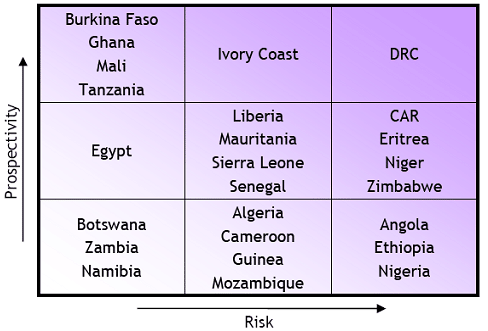
Miners Seeking Deposits in High-Risk Regions, Consultant Says


Mining companies, including Rio Tinto Group (RIO) and Vale SA, are increasingly looking for ore bodies in regions with high political and security risk as they struggle to meet commodities demand, a risk consultant said.
“The mining industry is actually an industry in crisis,” Michael Humphreys, managing director at strategic consultancy Control Risks in Sydney, said in an interview. “There’s this concern about getting their hands on leases - if you’re an exploration geologist, all the good sites have been pegged.” Read more here...